Why Do They Have to Drill a Hole in Somebodys Leg to Get Their Heart Started Again
CARDIAC ARREST;
CARDIO-PULMONARY RESUSCITATION; CPR;
CHEST COMPRESSIONS;
VENTRICULAR TACHYCARDIA; VT; V-TACH;
VENTRICULAR FIBRILLATION; VF; V-FIB; DEFIBRILLATION; CARDIOVERSION
The word cardiac means "middle" and "abort" means stop. If the center stops pumping for any period of time, the event is called a "Cardiac Arrest". If the heart stops pumping for > 5 minutes, the risk of brain damage increases. Resuscitation is a term used to describe efforts to restart the heart and restore normal apportionment.
Cardiac arrests are often referred to as "witnessed" or "unwitnessed" events . A cardiac arrest is called unwitnessed if the patient is found without a pulse and no i was present at the time the patient collapsed. About cardiac arrests in a critical care unit volition be "witnessed" because the patient is usually continued to a middle monitor (or ECG). Unwitnessed cardiac arrests carry a loftier risk for brain damage because patients have often gone longer than 5 minutes before resuscitation efforts were started.
When a patient'due south heart stops beating, the first intervention is CardioPulmonary Resuscitation (or "CPR"). The first person to identify the cardiac arrest begins pressing on the patients chest in an attempt to "squeeze" the heart and cause blood to flow. This is called "Chest Compressions" (Epitome three). The patient is chop-chop connected to a heart monitor to discover out the patient's electrical pattern. The pattern volition help the team to decide the next steps to take.
Ventricular Tachycardia (also called "VT" or V-Tach) is a type of electric disturbance where the ventricles (or bottom chambers) being to beat very fast. If they vanquish besides quickly (usually at rates > 200 beats per minute), the heart may become also ineffective to produce a detectable pulse. This blazon of rhythm can deteriorate quickly into a very chaotic quivering of the ventricles called Ventricular Fibrillation (also chosen VF or 5-Fib) . During Ventricular Fibrillation, the center is not pumping whatsoever blood at all.
Ventricular Fibrillation is treated past a quick electrical shock that causes the centre to completely stop. The daze is usually delivered through paddles that are placed on the patient'southward breast. This process is chosen Defibrillation. Sometimes, if the middle is stopped completely, the centre will restart itself inside a few seconds and render to a normal electrical pattern.
Aberrant heart patterns that cause the eye to burn down extremely fast usually originate from cells that are exterior the normal electrical pathway. Sometimes, we may need to stupor a eye to go it out of a very fast rhythm. If the patient has a pulse or blood pressure when nosotros deliver the shock, the shock we deliver is called "cardioversion" . The main difference between defibrillation and cardioversion is "when" the stupor is delivered. Defibrillation is used when the patient has no design to their electrical activeness, therefore, the shock is delivered at whatsoever bespeak in the rhythm. When cardioversion is used, the motorcar looks at the design, and delivers the shock between beats.
Considering the heart has usually been deprived of oxygen for a shorter period of time when cardioversion is used, the eye will often answer to a lower amount of electrical current. Cardioversion may as well be performed in "not emergency" situations (chosen electively). If the situation is non urgent, the physician may discuss the planned cardioversion in advance. Considering defibrillation is always a medical emergency, there is usually no time to explain the procedure earlier the patient is defibrillated.
Cardioversion and defibrillation are performed using the same automobile, and are done for the same purpose (to stop the eye and allow aberrant rhythm to return). Because of this similarity, health care professionals often used the ii terms interchangeably.
In addition to electrical shock, resuscitation efforts following cardiac abort will usually include the administration of drugs to correct low claret pressure and may include medications to prevent abnormal rhythms from occurring. The patient may require extra fluid and may be placed on a mechanical ventilator. Occasionally, the patient may require an bogus pacemaker.
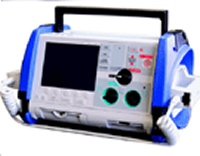
Image one:
Machine used to defibrillate or cariovert.
Source: https://www.lhsc.on.ca/critical-care-trauma-centre/critical-care-trauma-centre-263
0 Response to "Why Do They Have to Drill a Hole in Somebodys Leg to Get Their Heart Started Again"
Post a Comment